Our Written Testimony on the Impact of 287(g) to US Congress
May 14, 2026
The expansion of the 287(g) program in Texas has created a system in which local law enforcement agencies increasingly function as extensions of ICE. Routine interactions with police — including traffic stops and requests for assistance — now carry the risk of detention, deportation, and permanent family separation.
Topics: 287(g), Immigration, Smith county
Testimony of Dalila Reynoso
Lead Mental Health Advocate & Crimmigration Advocate
Email: dalila.reynoso@texasjailproject.org
Phone: (903) 258-0005
Good morning Congressmembers,
Thank you for the opportunity to testify today.
My name is Dalila Reynoso, and I work with Texas Jail Project, a small nonprofit advocacy organization founded in 2008.
Texas Jail Project monitors conditions of confinement in the 244 county jails across Texas and advocates on behalf of the more than 76,000 people held daily in these facilities, over 75 percent of whom are pretrial detainees. We organize with people incarcerated in county jails and their loved ones outside with the mission to shrink mass incarceration.
Our work focuses on cash bail, the criminalization of mental illness and disabilities, deaths in custody, and the use of county jails for immigration enforcement. Our vision is to replace punitive systems with communities of care.
I. Background: Expansion of 287(g) in Texas
I was born and raised in Tyler, Texas, where I have lived for over 40 years. Tyler is the county seat of Smith County, located approximately seven hours from the nearest border town. Despite its distance from the border, Smith County has long been at the forefront of immigration enforcement partnerships through the federal 287(g) program. Since 2013, the Smith County Sheriff’s Office has operated the jail-based 287(g) model.
In 2025, during the 89th Texas Legislative Session, Texas passed Senate Bill 8, mandating sheriffs in counties operating jails to request and enter into 287(g) agreements with U.S. Immigration and Customs Enforcement (ICE). The law formalized and expanded local participation in federal immigration enforcement. Counties with populations over 100,000 were required to comply, while smaller counties were strongly encouraged to participate. Sheriffs who failed to comply could face legal action from the Texas Attorney General.
In February 2025, Smith County was among the first counties to aggressively revive and expand the 287(g) task force model. As of February 3rd, 73% of Texas’s 233 counties with jails and subject to the law now have 287(g) agreements in place as of February 3.
Local law enforcement agencies claimed that SB 8 was sold to them as a tool for targeting undocumented people with criminal backgrounds. Instead, over the past eight months, our organization has witnessed firsthand how county jails and the pretrial detention system is increasingly being used for immigration enforcement. Routine traffic stops and low-level infractions are now serving as gateways to detention and deportation. Even passengers in cars that were pulled over for traffic stops have been abducted by local law enforcement for ICE despite having no criminal history. We have also observed municipalities carrying out immigration enforcement actions even before formal 287(g) agreements were finalized.
My testimony today is based on findings from dozens of open records requests that our organization filed for arrest reports, incident reports, bodycam footage and extensive interviews with directly impacted individuals and their families, and conversations with local law enforcement.
II. Impact on Communities and Constitutional Concerns
Texas’s expansion of the 287(g) program has transformed local sheriffs and police officers into seamless extensions of federal immigration enforcement. The distinction between local policing and ICE operations has become so blurred that community members no longer know whether a routine interaction with local law enforcement could result in detention or deportation.
These programs are often framed as public safety initiatives, but their real-world consequences have been devastating for immigrant families and entire communities. The growing collaboration between local law enforcement and ICE raises profound concerns about due process, equal protection, racial profiling, and the erosion of trust between communities and law enforcement agencies.
People are increasingly being targeted based on their race and ethnicity, on an officer’s subjective “belief” that someone may be undocumented. Communities are living in constant fear, avoiding contact with law enforcement, and experiencing lasting trauma from family separation and detention.
III. Example One: Jay’s* Story — Enforcement Without a Formal Agreement
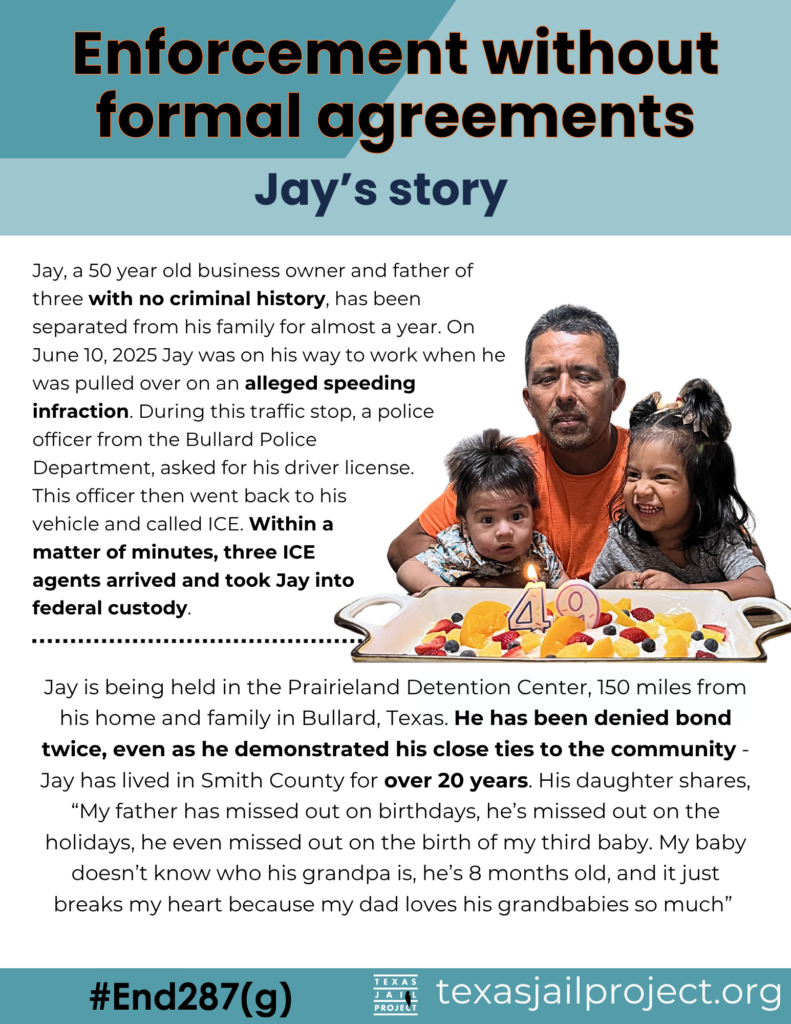
Jay is a 51-year-old man who has lived in the United States for more than 32 years. He is a business owner who operates a lawn service company and is the father of three and grandfather of three. All the children and grandchildren are United States citizens. Jay has no criminal history.
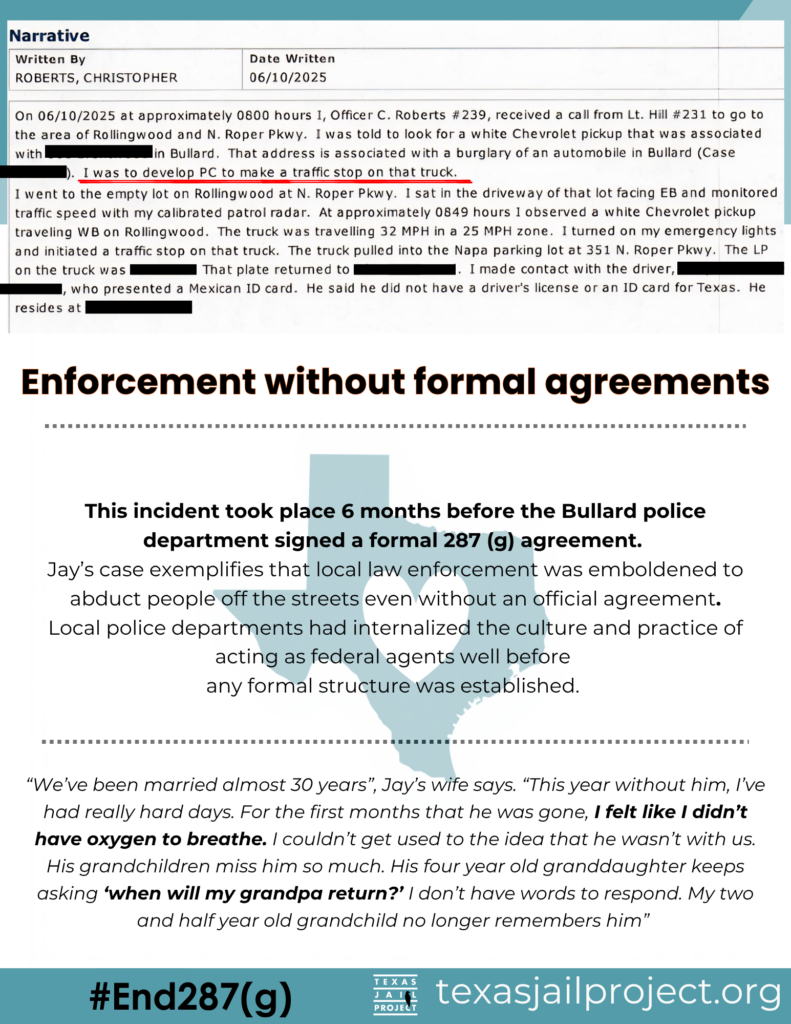
On June 10, 2025, Jay was driving to work when he was pulled over by a Bullard Police Department officer for an alleged speeding infraction. During the stop, the officer took Jay’s driver’s license, returned to the patrol vehicle, and called ICE. Within minutes, three ICE agents arrived at the scene.
Jay was immediately transported to an ICE detention center near Dallas, where he remains detained today after being denied bond twice.
Importantly, this incident occurred six months before the Bullard Police Department formally entered into a 287(g) agreement with ICE. Jay’s case demonstrates that local law enforcement agencies had already internalized the practices and culture of immigration enforcement before any official framework existed.
The impact on Jay’s family has been severe. His wife and children have been left emotionally devastated and financially strained while trying to maintain both their household and his business in his absence.
IV. Example Two: Ray’s* Story — The Blurred Lines Between Local Police and ICE
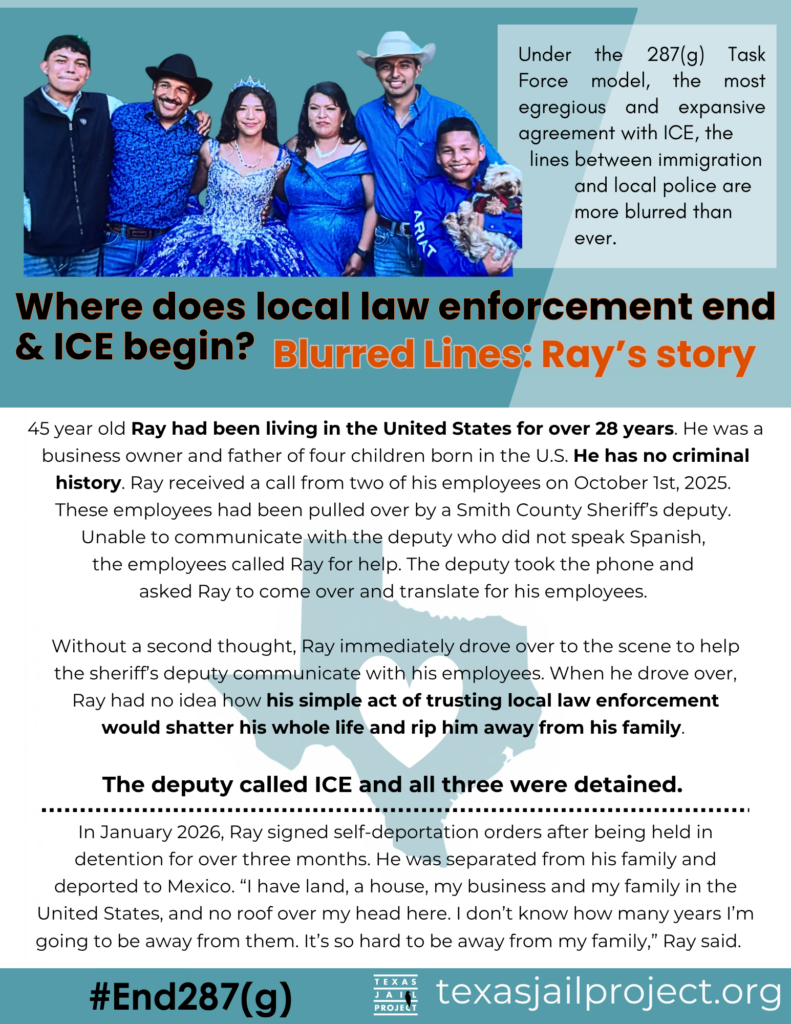
Ray* is a 45-year-old business owner and father of four U.S.-born children who had lived in the United States for more than 28 years. As in the previous example, Ray also has no criminal history.
On October 1, 2025, two of Ray’s employees were pulled over by a Smith County sheriff’s deputy. Because the deputy did not speak Spanish, they called Ray for help. The deputy took the phone and personally asked Ray to come to the scene to assist with translation.
Trusting local law enforcement, Ray immediately drove over to help. He had no reason to believe that his willingness to assist the Sheriff’s office would shatter his and his family’s lives.
When Ray arrived, the deputy called ICE. All three men were detained.
In January 2026, after more than three months in detention, Ray signed self-deportation orders and was deported to Mexico.
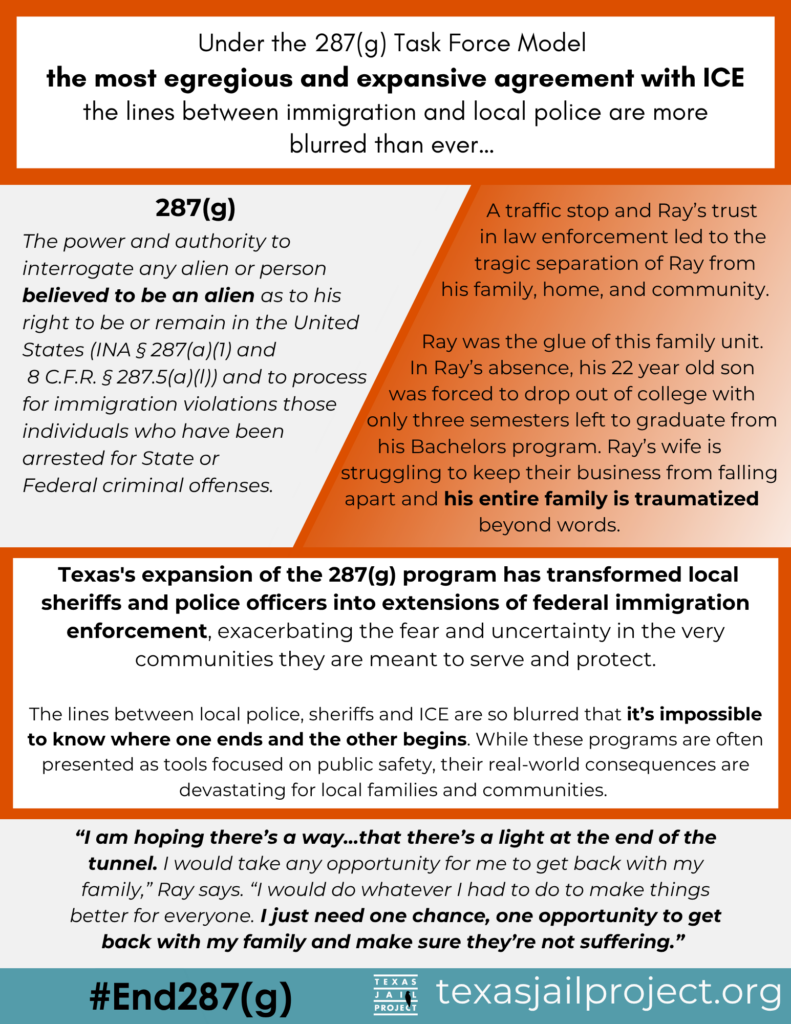
It is critical to note that Ray was not involved in the original traffic stop. His detention stemmed from broad language within the 287(g) agreements granting local officers authority to interrogate individuals they “believe” may be undocumented.
On a phone call from Mexico, Ray told me:
“I have land, a house, my business and my family in the United States, and no roof over my head here. I don’t know how many years I’m going to be away from them. It’s unbelievable what’s happened to me and my family.”
He also described the emotional impact on his children:
“They feel lost without me. I was their biggest cheerleader. I was always there for school drop-offs and soccer games.”
Ray’s deportation has devastated his family. With only three semesters remaining for graduation, his 22-year-old son was forced to drop out of college in order to help sustain the family business. His wife has struggled to prevent the business from collapsing. The entire family continues to experience profound emotional trauma.
This harm extends beyond one household. Incidents like Ray’s have created widespread fear throughout the community and severely damaged trust in local law enforcement.
V. Example Three: Dee’s* Story — Survivor of Collateral damage
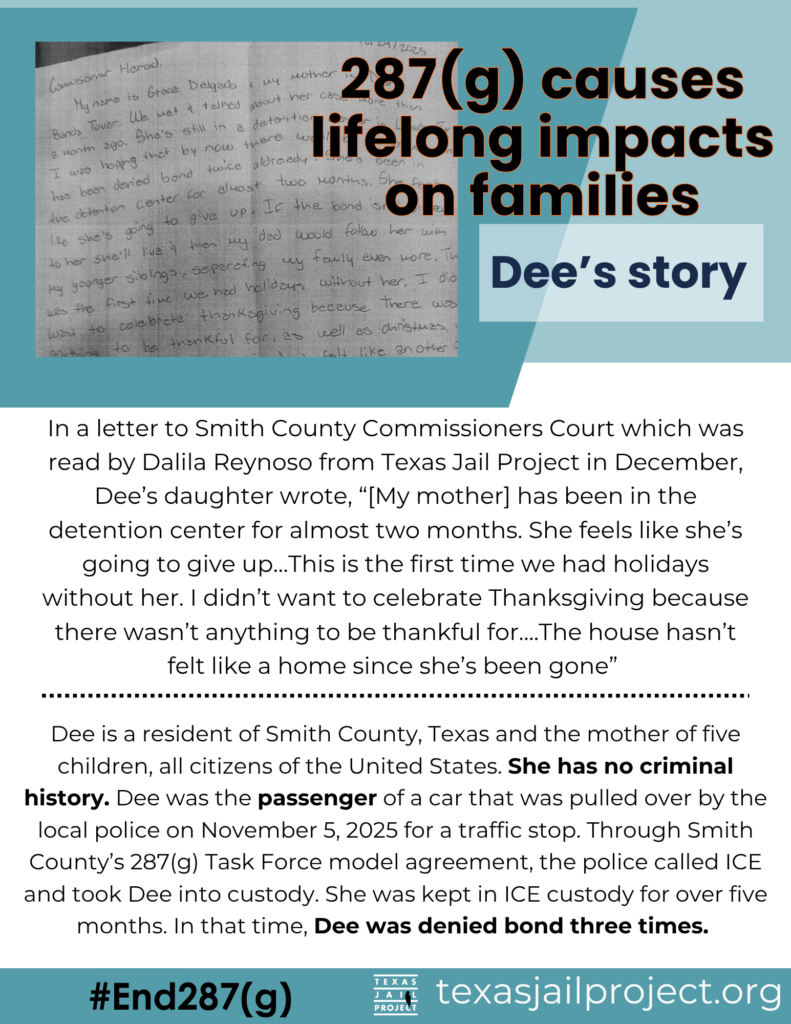
Dee is a resident of Smith County, Texas and the mother of five children, all of whom are U.S. citizens. She has lived in this country for over 20 years.
Dee was a passenger in a car that was pulled over by the local police on November 5, 2025 for a traffic stop. She has no criminal history. Through Smith County’s 287(g) Task Force model agreement, the police immediately called ICE and took Dee into custody. She was kept in ICE custody for over five months. In that time, Dee was denied bond three times.
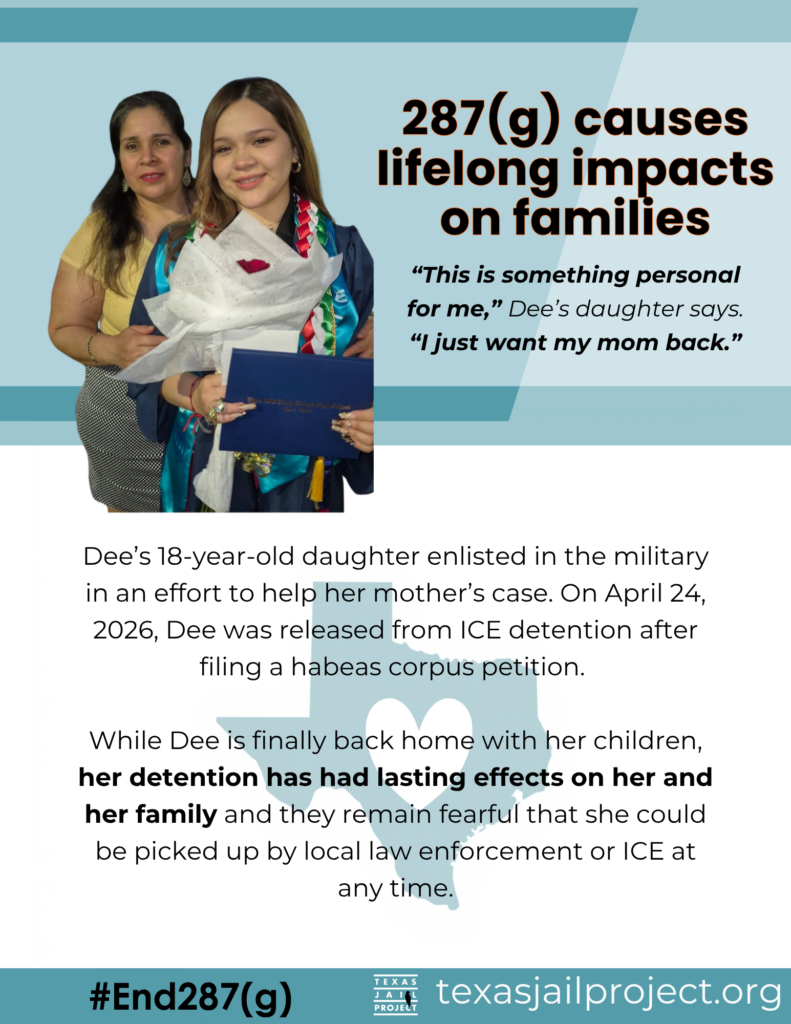
In a letter to Smith County Commissioners Court which I read in my public comment in December, Dee’s daughter wrote, “[My mother] has been in the detention center for almost two months. She feels like she’s going to give up…This is the first time we had holidays without her. I didn’t want to celebrate Thanksgiving because there wasn’t anything to be thankful for….The house hasn’t felt like a home since she’s been gone. “This is something personal for me,” Dee’s daughter says. “I just want my mom back.”
Dee’s 18-year-old daughter enlisted in the military in an effort to help her mother’s case. On April 24, 2026, Dee was released from ICE detention after a habeas corpus petition was filed.
While Dee is finally back home with her children, her detention has had lasting effects on her and her family and they remain fearful that she could be abducted by local law enforcement or ICE at any time.
V. Conclusion
The expansion of the 287(g) program in Texas has created a system in which local law enforcement agencies increasingly function as extensions of ICE. Routine interactions with police — including traffic stops and requests for assistance — now carry the risk of detention, deportation, and permanent family separation.
The stories of Jay, Ray and Dee are not isolated incidents. They reflect a broader pattern in which constitutional protections, due process, and community trust are being grossly undermined in the name of immigration enforcement.
The consequences are profound and long-lasting: families torn apart, businesses destroyed, children traumatized, and entire communities frozen in fear.
While these programs are often presented as tools focused on public safety, their real-world consequences have extended far beyond individuals accused of serious crimes and have deeply affected working families, children, and entire communities.
For many mixed-status households, the detention or deportation of a parent or primary wage earner creates immediate financial devastation. Families suddenly lose income needed for rent, food, utilities, transportation, and childcare. In many cases, U.S. citizen children are left facing emotional trauma, housing instability, interrupted education, and long-term psychological stress resulting from family separation.
These enforcement practices also carry broader consequences for public safety and community trust. Immigrant families are deeply woven into the social and economic fabric of this country. When immigrant communities fear that any interaction with local law enforcement could lead to immigration enforcement action, many individuals become reluctant to report crimes, cooperate with investigations, seek medical assistance, or engage with public institutions. This erosion of trust weakens relationships between law enforcement and the communities they serve and can ultimately make communities less safe for everyone.
As Congress considers the future of immigration enforcement policy, I respectfully urge this Committee to examine not only enforcement metrics, but also the human, economic, and public safety consequences of these programs. Policies that result in widespread family separation and community fear demand careful oversight, transparency, and accountability.
At this point, the ripple effects that destabilize families and strain social support systems, schools, and community organizations have spread so far and wide, we do not see a meaningful path toward repair unless these families are reunited and these enforcement practices are halted.
Thank you for your time and consideration.
Dalila Reynoso
* All names have been changed to protect their identity
Full List of 287(g) Resources